Showing posts with label tradition. Show all posts

Friday, 27 September 2013

Forever Hometown

        From the day I set up from Beijing International Airport till now, time has passed one month precisely. However I felt that I have left my home over one year. Can’t imagine, field school nearly draws to the end. I felt so worried about it when I still in China. I know I do poor English writing, but I still have to express my feelings by it in blogger. I was nervous when I was in my home- I just cannot speak English well, what about interview and investigate local people- I ever thought that quidi vidi people had totally different ethnical language compared with English and we need translators!… So far, I have done well. That’s what I feel comfort to myself. That is because of my friendly and helpful classmates; that is because of conscientious and considerable teachers; that is because of lovely and self- giving quidi vidi people…

        I learned so much in this precious period, not including the field investigation experiences I have added. I drew first professional building draft in my life; I interviewed a totally foreigner for me in one hour; I talked with two Newfoundlanders over 4 hours… As well as joining a banquet in a heritage building nearly 200 years, dancing and drinking in a wholly Newfoundland style kitchen party, “screeching” in the Inn of Olde for becoming a honorary Newfoundlander… Maybe after screechin, I definitely became a Newfoundlander and had same sentiments with the people and understood them profoundly. I learned many fishing common sense and knowledge of stage. I let waves from Atlantic Ocean wet out my pants and shoes when I was bumped till left to right in Frank’s boat. Right in that moment, I thought the waves would capsize the boat!

        So many precious memories… let me begin with my first English interviewer Peggy Magnone. She is so kind that she speaks slowly and tries her best to understand me and response me. To this intelligent and generous old lady, I don’t know what to say in this moment. Her tears nearly dropped down when she talked about her hardship period when she was young. I can’t imagine that a lady so optimistic still owns memories about hardships. I completed my interview smoothly in the help of the considerate old lady. But she looked so sad to let us go. I remembered her hardy face when she said goodbye to us- she even did not dare to look straight to us. I felt her strong sentiments of sorrow and pity that she knew that we did not belong to her from beginning to the end. I felt sad these days when I remembered her words and face. She said that you can come to see me interview or not interview… You can call me whenever you want… People in quidi vidi are so sentimental that I can’t help laughing and crying altogether with them.


Peggy Magnone and I with little Comet- Photographer: John LaDuke

         I interviewed John and Anne the day before yesterday. I know that Johnny has always waited for someone to interview him- he is so enthusiastic to field school and he and Anne love us so much. Interview completed as I imagined same as Peggy, but beyond my imagination was that we chatted nearly 4 hours after interview… From family fairs to political events, we chatted like old friends. They were so frank that they ask my advice for their private fairs. And I put myself in their position to the best of my ability to comfort them. They are so kind people that when I think of them, tears nearly running down. They trust me rather than I trust them. The trust is what kind of a good feeling! Today, they gave me a postcard by the hand of Christine. I was shocked again. Blessing and sentiments are flowing and going on. They taught me be grateful and be kind to everyone everything.

Kind John with a smile similar with the meerkat standing in the flowerpot
John pretends to be annoyed to Anne's superstitious habit to angel 
John, Anne and I hold Queen together- Photographer: Christine Blythe
     
        I have to talk about the Mallard banquet yesterday. The owner of Mallard Cottage Todd treated all of us in the old heritage building nearly 200 years. When I stepped into the house, I smelt a familiar flavour of burning wood. Yes, they burned woods in the original fireplace to make an old atmosphere. The whole old cottage belonged to us in the 3 hours. It was a bounteous meal including wine, salad, dish and desserts in exquisite procedures. I can’t remember the name of main dish… which harbour cod fea? Forgive me. “fi” is a local term means meal. I was full but dessert came. I was full further but the second dessert came…… Desserts were composed by two kinds of bread poutine and cream and blueberry sauce. Totally wonderful experience for me. The cookers and servers as well as the owner treated us with the utmost cordiality. Thanks a lot! Mallard Restaurant will open in October. Booming business!

        We will return back to classroom from field next week. But the faces of local people and the scenes will be engraved in our mind forever.  I deeply felt the love from local people to their hometown- quidi vidi village. And quidi vidi will be our hometown forever.Thank you all again and again and again…

Elegant Lisa and Adrian who  poses a gentleman in Middle Ages
A corner of Mallard Cottage Banquet
Old fireplace put warmth and feelings to us
Delicate tableware with carved pattern
Cheers! Everyone!


(Above photos all were shot by Wang Xuan except the ones illustrated)

The Many Faces of Quidi Vidi

When we arrived in Quidi Vidi, our first two weeks were, for the most part, full of bright and warm weather. Since then, it has been getting steadily cooler and wetter outside as the rain carries on and keeps most people inside for the day. At first glance, venturing outside even just into thick fog rather than the rain seemed uninviting as I looked at the gray, quiet waters of the harbor from the comfort of the dry, cozy room inside the plantation building where we worked, mugs of tea or coffee in hand.

A view of the harbor from inside the plantation building. Photo by Klara Nichter.

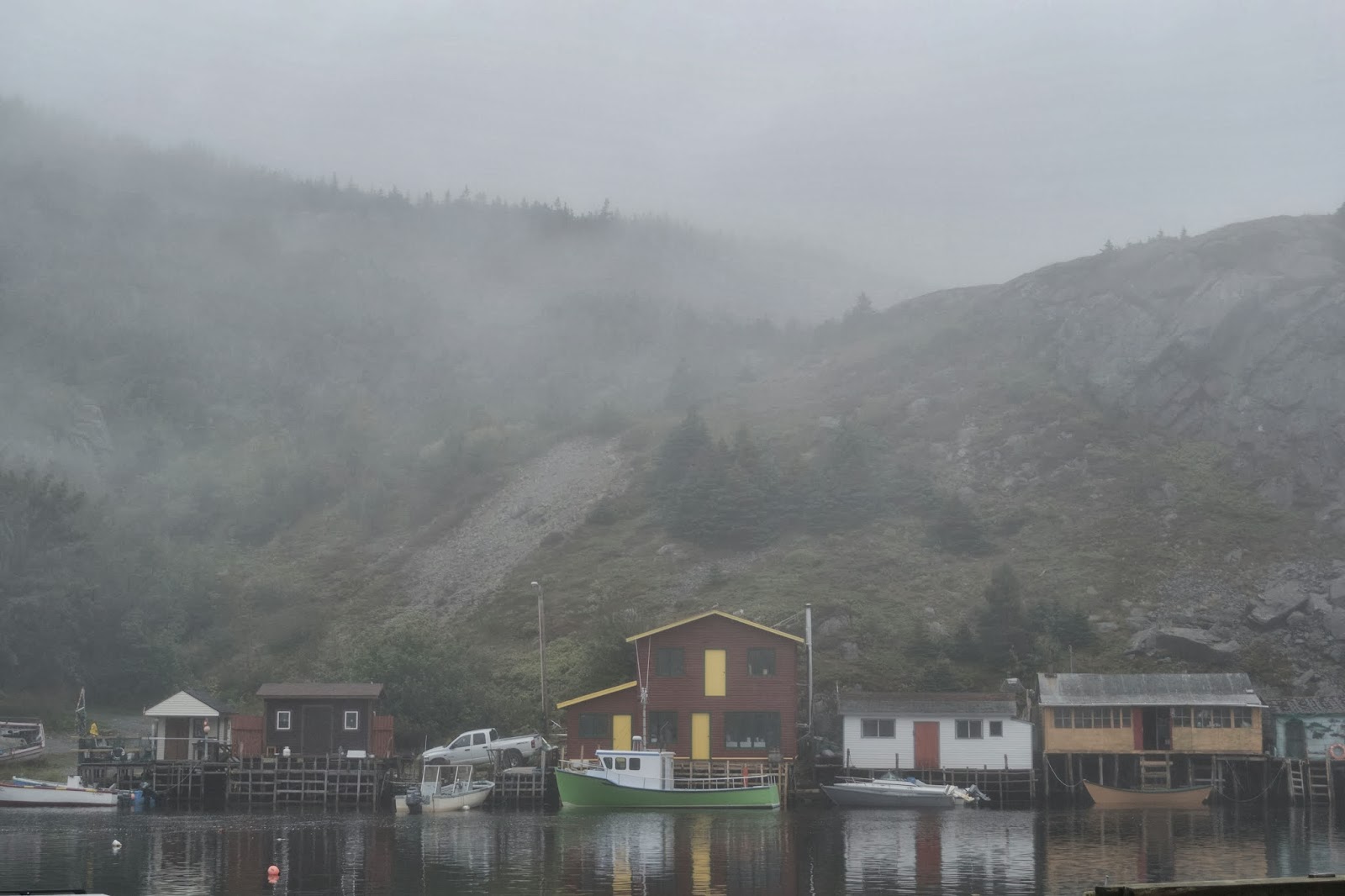
When I did venture out later that afternoon, however, it turned out that Quidi Vidi was as inviting as ever despite the lack of activity in the harbor and the ever-thickening fog that day. The fog only added to the striking nature of the view as I wandered out to Landrock to have a look at the rough waters that led most people to stay in and save their fishing for another day. Having come from a landlocked part of the United States, I was awed by the dramatic sight of the waves and struck by the calm of the waters by the time they flowed into the village harbor.


Quidi Vidi stages shrouded in fog. Photo by Klara Nichter.

The view as I headed out towards Landrock. Photo by Klara Nichter.

Crossing the rocky beach towards Landrock. Photo by Klara Nichter.

The end of the trail. Photo by Klara Nichter.

A view of the rough sea from Landrock. Photo by Klara Nichter.

More views of the waves from Landrock. Photo by Klara Nichter.

Heading back to the calm waters of Quidi Vidi. Photo by Klara Nichter.

As I considered how inviting Quidi Vidi was even in seemingly bad weather, my thoughts turned from the scenic surroundings to all of the people and their buildings that we have gotten to know over these few weeks. We have gone from strangers in a seemingly alien place to friends in a familiar one, largely thanks to the kindness and generosity of so many people who have welcomed us into their homes and stages and shared their lives in the village with us. Rain or shine, it seems that whenever you go out exploring here, there will always be something new and wonderful to be discovered.

Saturday, 21 September 2013

Learning in Stages

Yesterday, we continued to learn how to document buildings from expert Ed Chappell. This time, the group project was to measure and then draw an elevation of Barry Pittman's fish stage. Since an elevation is a representation of the complete view of one side of a building, creating one involved a great deal of exploring the stage in order to get the correct measurements and drawing on paper, from banding together to measure beams from a precarious floating dock to crawling underneath the stage to fill in all of the rocks that form part of the foundation that keeps the stage above water.

Barry Pittman's stage. Photo by Klara Nichter.

Ed Chappell, Wang Xuan, Christine Blythe, and Kayla Carroll work on measuring the stage. Photo by Klara Nichter.

The reason that we should still learn to draw an elevation of a building rather than just take a picture of the same view, we learned, is that measuring and drawing the building leads to a greater understanding of it. As I scooted slowly along the edge of the fish stage, shepherding the tape measure from pole to pole, I began to experience the difference myself. I had taken photographs of the stage, but it was not until I was on the stage to measure it that I really stopped to consider the distinctive nature of this structure. The striking combination of the poles at the front of the stage, fashioned from logs still rough with bark, and the smooth boards of the deck where I worked led me to reflect on the particular makeup of the fish stage, a new structure that mirrors past stages in Quidi Vidi due to its construction using the traditional design. Though there are many new buildings in the village, the old ways appear to be alive and well right alongside them in the form of stages such as the one we documented.

The front of Barry Pittman's stage. Photo by Klara Nichter.

Wednesday, 18 September 2013

If Walls Could Talk


Monday we began the section of the field school on vernacular architecture.  Ed Chappell, an architectural historian who works at Colonial Williamsburg, is our guest lecturer and has been teaching us how to draw architectural floor plans. During the past three days we have learned the techniques used to draw floor plans and have spent several hours discussing their utility. I’ll have to admit, as someone who was drawn to folklore, almost exclusively, on her own obsession for people and their stories, architecture fell somewhere on the scale between mildly interesting and hardly interesting at all. While historic buildings possessed a certain aesthetic and historical significance that I found fascinating my interest was grounded in the people who lived there, rather than the structural artifact itself.

 However, yesterday, as we stood in the Mallard home mapping out its dimensions, meticulously examining the wood, carefully estimating the approximate location of relics now absent, I realized that this home and these vestiges of the past told a story, a very intimate story about the residents who once lived there. The ropes and rags that peak through the wooden panels snuggly positioned along the wall, the remnants of a small lobby roughly etched into the wood, the special elements of the room, and the methodically placed windows all collectively illuminated the past experiences, technologies, and even daily flow of life for the residents who once inhabited the Mallard home. 

There is the saying “if these walls could talk…” well I am beginning to think that they do, but we need special skills to make their voices audible. (And after today, I'm realizing it takes a lot of work to make them audible.)

Ed Chappell sketching the outer
walls of the Mallard Cottage

Beam on North wall of Mallard Cottage
Artistic shot of the window, roof, beams, and lighting
fixture in the Mallard Cottage


Ed Chappell drawing floor plan

Christine Blythe's feet on original wood floor
in the Mallard Cottage


Tuesday, 17 September 2013

Buildings, Memories, and Tradition

On Monday afternoon, Anne Barnes chatted with John LaDuke and I about how Quidi Vidi has changed over the years. One site across from her house has gone from fish plant to restaurant to vacant building. Another has become the Quidi Vidi Village Plantation building, where field school classes take place and tourists seem to flow constantly in and out throughout the day as they explore the village. The number of residents is also increasing as Quidi Vidi becomes known as much for its beautiful views now as it was for its fishing industry in the past.

Later that afternoon, Ed Chappell, the director of architecture and archaeology at Colonial Williamsburg, Virginia, led us on a tour of Quidi Vidi's architecture. When we arrived at the Hennebury house, which may have been built as early as 1749, we found surprisingly little physical evidence of its history. The structure of the original house remains, but vinyl siding now covers the exterior while modern walls inside mask the original exposed timber. The house's past was not lost, however, as Eric Sneilgrove was able to tell us about the house's construction prior to its renovations in great detail. The root cellar might now be part of a modern a basement, for instance, but Sneilgrove told us how this basement space used to serve as the original cellar and housing for a pony.

Eric Sneilgrove shows us the house's original root cellar (through the blue door). Photo by Klara Nichter.

Ed Chappell points out the details of the basement wall. Photo by Klara Nichter.

When we continued on our tour, we found more evidence of residents' preservation of Quidi Vidi's historic architecture. Although Mallard Cottage, another of the village's earliest buildings, no longer features solely historic architecture either, its owner is in the process of reconstructing it as faithfully as possible to its original design. Likewise, local heritage carpenter Aiden Duff is currently working on restoring his home, originally the village church. Items such as the materials and bright red paint used to construct the new church steeple might be new, but the resulting structure mirrors the original architecture of the church.

Aiden Duff's workshop (red building) and home (the church).Photo by Klara Nichter.

By the end of the tour, it was apparent that although Quidi Vidi is changing in many ways, its residents are also taking steps to preserve its heritage. Whether through the memories of those who inhabit its historic structures or through the reconstruction of the buildings themselves, Quidi Vidi's history lives on alongside its new developments.

Sunday, 15 September 2013

Photos From My Wanderings: A Guest Post by Lisa

Dr. Pocius and Guha Shankar (guest lecturer) prepare the equipment for our staged interview with China Snow. 
The amazingly knowledgable China Snow engages Dr. Pocius with information around the local fishery. 

During an oral history with Peggy, she rifles through old papers she has collected on life in QV over the years.

Peg, now in her 90s,  pulls out an old photograph of her daughter when she was just a toddler. 
Residents Greg Walsh, Eric Sneligrove and Aiden Duff take a moment to pose for a photograph.
Aiden Duff, a heritage carpenter, stands back to reflect on his day's work.
Ignored objects in QV, found along the path behind the Sneligrove's place (known as "the lane way.") 
In the Ring house, one can learn about the importance of displaying family achievements. 
The home can also be a place for demonstrating faith and nostalgia (I like the archival photograph of the Newfie Bullet on the wall). 
The brick interior of the Barnes' shed, with his important nautical-themed objects scattered about. 
Johnny Barnes, always agreeable and willing to pose, holds up some ephemera from his personal collection.

Monday, 9 September 2013

Quidi Vidi Charm


Last night we kicked off the field school at a quaint pub near the bay in Quidi Vidi. The room was filled with eclectic knickknacks – not a bare wall in the house -, sea shanti folk tunes filled the air, and a charismatic Newfoundlander named Linda welcomed us not only into her pub, but into her home – sharing stories about her life, beliefs, and art. It was a perfect prelude to the field school and a great introduction to the community as whole.


Linda's Pub. Her sign reads: "Linda's Stories,
 Beers & Wood Burning Stoves

This morning, John Mannion, a historical cultural geographer of Newfoundland demography, shared with us in detail the modern and historical cultural landscape of Quidi Vidi – a 400-year period, especially rich in the tradition of jigging for cod. Uninhabited by indigenous peoples nearing the 16th century, Quidi Vidi would become a seasonal point of resources for the larger transatlantic region – bringing in fisherman from Great Britain, France, Spain, Ireland, and New England. The community’s landscape has transformed drastically over the centuries but the scenic old world charm and traditional maritime culture is still what makes Quidi Vidi so attractive.

The Gut of Quidi Vidi Harbor 

After lunch we walked the village, Mannion shared with us some of the historically significant sites and introduced us to some great members of the community- all of whom to which I look forward to becoming more formally acquainted.

After our classes ended for the day, Kayla and I explored the village. Climbing the massive rocks that surround the bay we were able to capture a few picturesque shots of Quidi Vidi.


Christine overlooking Quidi Vidi Village

We also met Eric Snellgrove and his grandson Ethan who showed us their potato garden, and jigging equipment, which was stored in a shed Snellgrove had built adjacent to his garden. Although we did not have the opportunity to visit his home, which is the oldest restored home in Quidi Vidi, he did give us a tour of his cellar where the original stonewalls still stand. We plan on visiting again soon and perhaps receiving my first jigging lesson ever (since Kayla is already an old hand).


Eric Snellgrove and his great grandson Ethan standing
in front of his potato garden
The door leading into Snellgrove's Cellar 

As we turned toward the plantation (this is where the majority of our lectures are held) we saw Johnny Barnes standing on his ladder out side his home. We approached him, and he and his wife, Anne, warmly invited us to their backyard. Their yard runs parallel to a stream and overlooks the harbor. During our conversation, Johnny sat in his comfy armchair, which is interestingly placed in a shed (A shed he made with his own hands) and spoke about Quidi Vidi with warmth and nostalgia. He shared with us his hopes that Quidi Vidi would be preserved and its rich history along with it.


JohnnyBarnes sitting inside his shed 

Johnny and Anne Barnes with their sweet pup


We couldn’t have hoped for a better day.

The Old With the New


Our field school started yesterday evening with an informal, introductory supper at the Inn of Olde. Though that was only a little over 24 hours ago, there is much to tell and many things we have already learned. We’ve received a lovely welcome from many of the local residents and have a lot to look forward to in the coming weeks. Thankfully you, our faithful readers, will get a daily update from two of us, because I must admit that as I’ve reflected on what to share in this post, it seems impossible to completely capture everything!

Last night was, in my mind, the perfect way for us to have been introduced to Quidi Vidi. Because we’re all still so new to one another, it was great to hang out and chat and enjoy a bowl of homemade chili/turkey soup/ seafood chowder from the very likeable and lively Linda Hennebury, owner of the Inn. After eating, we were treated to Linda showing us her paintings and completely capturing the crowd with her engaging stories about the eight male ghosts in her house. She is an entertaining storyteller because Linda is able to weave in and out of stories with ease while drawing in her audience and making connections. In one story about her granddaughter, for example, she tells us her granddaughter is just a young thing “like you,” pointing to me and allowing me to enter into the story, as though it could just as easily as happened to me. We all got quite a lot of enjoyment from all her proclamations of affection for our professor as well... :)

Linda Hennebury captivating us with her stories
Photo: Wang Xuan

We started out this morning bright and early at Quidi Vidi Plantation. We were fortunate to be joined by Dr. John Mannion, a retired Geography professor from MUN who is one of Canada’s leading cultural geographers and an expert on Newfoundland settlement. The first couple hours were spent learning about how Quidi Vidi was settled and what the village would have looked like during the migratory, bye-boat, and planter fisheries. We also looked at some photos from the DAI (Digital Archives Initiative), keeping in mind that many of the stages and flakes we were looking at were built as impermanent structures. Dr. Mannion then took us on a comprehensive tour around the village, from the North East side where we explored the Gut and harbour, the Landrock (and imagining structures such as the flake house), and finally west down to the village. Among the highlights was a walk through Mallard Cottage, which is in the final stages of transformation into a restaurant by owner Todd Perrin, a chat with carpenter Aiden Duff who is restoring an old Anglican church and who showed us around his shed, and ended back at the Plantation where we talked to the knowledgeable Eric Snow, known locally (and, as he explained, exclusively) as China.

Quidi Vidi Plantation- our "homebase" for the next three weeks
Dr. Mannion, Jerry and students chat about Mallard Cottage
 
Aiden Duff and Dr. Mannion talk about his restoration progress You need to take a boat to get to these stages- someone sign me up!

A recurring theme today was the juxtaposition of old and new in Quidi Vidi. Everywhere we went, there seemed to be remnants of the traditional mixed, and often right alongside, the new and modern. A great example of this is the “giant monster” house along the North side towards the Gut. It looms over all who walk by and is a very modern structure (even complete with plexiglass along the deck to compete with the wind). Right next to it, though, are several fishing stages that, although they are no longer used for the commercial fishery, are still traditional in structure.

The Old with the New
Our day ended a little early today, so Christine and I decided to walk around and orient ourselves as much as possible to the landscape. We were hoping to meet some local people (and work up the nerve to talk to them), and after a couple of failed attempts, we lucked into meeting some very nice and friendly people. Eric Snelgrove, who lives in the oldest standing structure in Quidi Vidi, the Hennebury House, was out trimming up his garden. He showed us his garden, shed, and around his cellar (which we will dig into a little deeper in the coming days). He also told us he’d take us out during the food fishery- an offer we’ll take him up on! On our walk back to the Plantation, we also met Johnny and Anne Barnes and chatted with them about life in Quidi Vidi and how it has changed in the years they’ve lived there. Both Johnny and Anne were filled with knowledge and kindness and we plan on heading back there to further pick their brains. One of the nice things about this field school is the opportunity to meet such fantastic people. I've never before had to challenge myself to talk to people in such an open way, so today was a good experience in learning how rewarding it can be just to simply ask someone how their day is going and what they've been up to.
Eric Snelgrove and his great-grandson Ethan pose for a snap
Johnny and Anne Barnes (and their sweet dog, Queen) showed us their shed and talked to us about their experience living in Quidi Vidi

Needless to say, it’s been a busy day!

Kayla Carroll