Showing posts with label Quidi Vidi. Show all posts

Friday, 27 September 2013

Forever Hometown

        From the day I set up from Beijing International Airport till now, time has passed one month precisely. However I felt that I have left my home over one year. Can’t imagine, field school nearly draws to the end. I felt so worried about it when I still in China. I know I do poor English writing, but I still have to express my feelings by it in blogger. I was nervous when I was in my home- I just cannot speak English well, what about interview and investigate local people- I ever thought that quidi vidi people had totally different ethnical language compared with English and we need translators!… So far, I have done well. That’s what I feel comfort to myself. That is because of my friendly and helpful classmates; that is because of conscientious and considerable teachers; that is because of lovely and self- giving quidi vidi people…

        I learned so much in this precious period, not including the field investigation experiences I have added. I drew first professional building draft in my life; I interviewed a totally foreigner for me in one hour; I talked with two Newfoundlanders over 4 hours… As well as joining a banquet in a heritage building nearly 200 years, dancing and drinking in a wholly Newfoundland style kitchen party, “screeching” in the Inn of Olde for becoming a honorary Newfoundlander… Maybe after screechin, I definitely became a Newfoundlander and had same sentiments with the people and understood them profoundly. I learned many fishing common sense and knowledge of stage. I let waves from Atlantic Ocean wet out my pants and shoes when I was bumped till left to right in Frank’s boat. Right in that moment, I thought the waves would capsize the boat!

        So many precious memories… let me begin with my first English interviewer Peggy Magnone. She is so kind that she speaks slowly and tries her best to understand me and response me. To this intelligent and generous old lady, I don’t know what to say in this moment. Her tears nearly dropped down when she talked about her hardship period when she was young. I can’t imagine that a lady so optimistic still owns memories about hardships. I completed my interview smoothly in the help of the considerate old lady. But she looked so sad to let us go. I remembered her hardy face when she said goodbye to us- she even did not dare to look straight to us. I felt her strong sentiments of sorrow and pity that she knew that we did not belong to her from beginning to the end. I felt sad these days when I remembered her words and face. She said that you can come to see me interview or not interview… You can call me whenever you want… People in quidi vidi are so sentimental that I can’t help laughing and crying altogether with them.


Peggy Magnone and I with little Comet- Photographer: John LaDuke

         I interviewed John and Anne the day before yesterday. I know that Johnny has always waited for someone to interview him- he is so enthusiastic to field school and he and Anne love us so much. Interview completed as I imagined same as Peggy, but beyond my imagination was that we chatted nearly 4 hours after interview… From family fairs to political events, we chatted like old friends. They were so frank that they ask my advice for their private fairs. And I put myself in their position to the best of my ability to comfort them. They are so kind people that when I think of them, tears nearly running down. They trust me rather than I trust them. The trust is what kind of a good feeling! Today, they gave me a postcard by the hand of Christine. I was shocked again. Blessing and sentiments are flowing and going on. They taught me be grateful and be kind to everyone everything.

Kind John with a smile similar with the meerkat standing in the flowerpot
John pretends to be annoyed to Anne's superstitious habit to angel 
John, Anne and I hold Queen together- Photographer: Christine Blythe
     
        I have to talk about the Mallard banquet yesterday. The owner of Mallard Cottage Todd treated all of us in the old heritage building nearly 200 years. When I stepped into the house, I smelt a familiar flavour of burning wood. Yes, they burned woods in the original fireplace to make an old atmosphere. The whole old cottage belonged to us in the 3 hours. It was a bounteous meal including wine, salad, dish and desserts in exquisite procedures. I can’t remember the name of main dish… which harbour cod fea? Forgive me. “fi” is a local term means meal. I was full but dessert came. I was full further but the second dessert came…… Desserts were composed by two kinds of bread poutine and cream and blueberry sauce. Totally wonderful experience for me. The cookers and servers as well as the owner treated us with the utmost cordiality. Thanks a lot! Mallard Restaurant will open in October. Booming business!

        We will return back to classroom from field next week. But the faces of local people and the scenes will be engraved in our mind forever.  I deeply felt the love from local people to their hometown- quidi vidi village. And quidi vidi will be our hometown forever.Thank you all again and again and again…

Elegant Lisa and Adrian who  poses a gentleman in Middle Ages
A corner of Mallard Cottage Banquet
Old fireplace put warmth and feelings to us
Delicate tableware with carved pattern
Cheers! Everyone!


(Above photos all were shot by Wang Xuan except the ones illustrated)

The Many Faces of Quidi Vidi

When we arrived in Quidi Vidi, our first two weeks were, for the most part, full of bright and warm weather. Since then, it has been getting steadily cooler and wetter outside as the rain carries on and keeps most people inside for the day. At first glance, venturing outside even just into thick fog rather than the rain seemed uninviting as I looked at the gray, quiet waters of the harbor from the comfort of the dry, cozy room inside the plantation building where we worked, mugs of tea or coffee in hand.

A view of the harbor from inside the plantation building. Photo by Klara Nichter.

When I did venture out later that afternoon, however, it turned out that Quidi Vidi was as inviting as ever despite the lack of activity in the harbor and the ever-thickening fog that day. The fog only added to the striking nature of the view as I wandered out to Landrock to have a look at the rough waters that led most people to stay in and save their fishing for another day. Having come from a landlocked part of the United States, I was awed by the dramatic sight of the waves and struck by the calm of the waters by the time they flowed into the village harbor.


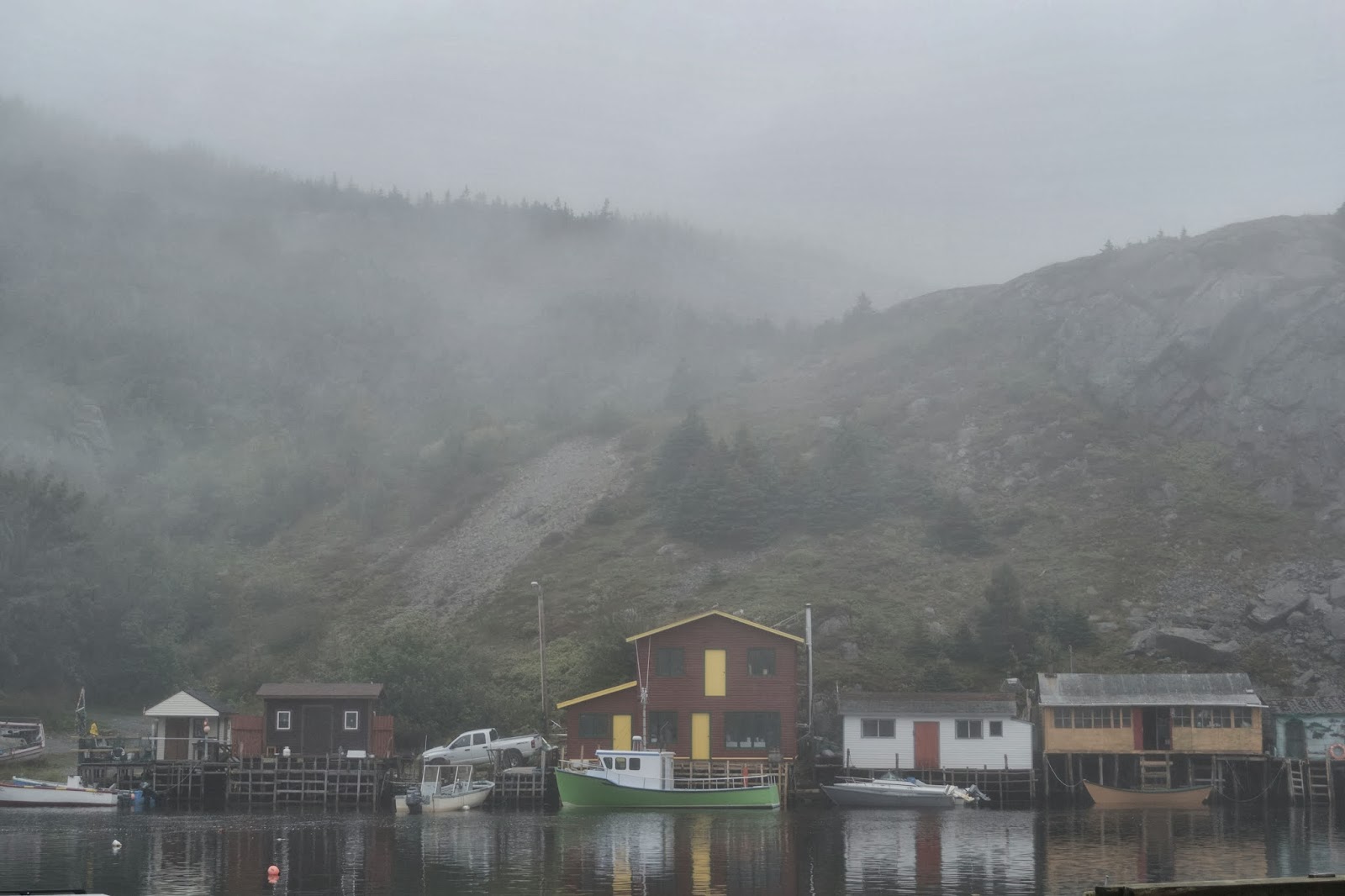
Quidi Vidi stages shrouded in fog. Photo by Klara Nichter.

The view as I headed out towards Landrock. Photo by Klara Nichter.

Crossing the rocky beach towards Landrock. Photo by Klara Nichter.

The end of the trail. Photo by Klara Nichter.

A view of the rough sea from Landrock. Photo by Klara Nichter.

More views of the waves from Landrock. Photo by Klara Nichter.

Heading back to the calm waters of Quidi Vidi. Photo by Klara Nichter.

As I considered how inviting Quidi Vidi was even in seemingly bad weather, my thoughts turned from the scenic surroundings to all of the people and their buildings that we have gotten to know over these few weeks. We have gone from strangers in a seemingly alien place to friends in a familiar one, largely thanks to the kindness and generosity of so many people who have welcomed us into their homes and stages and shared their lives in the village with us. Rain or shine, it seems that whenever you go out exploring here, there will always be something new and wonderful to be discovered.

Wednesday, 25 September 2013

Memories of Quidi Vidi

Today is the hump day of the last week of the Quidi Vidi field school and this is my final blog entry. As such, I feel that it is only appropriate for me to reflect upon my time in the village. In the last three weeks I have been blessed with the opportunity to meet countless wonderful people. The fact that so many residents of this village have openly told us their stories and welcomed us (complete strangers!) into their homes, sheds, stages and boats, is amazing and heart warming. 
 
Peg Smith and her dog comet 
When I arrived in Quidi Vidi on the first day of classes I felt a bit like a black sheep. I was the only non-folklorist, in a group of folklore students, at a folklore field school. Nevertheless, I quickly felt welcomed by instructors, fellow students, and those within the community. While all of the people that I have met have been truly special, I would like to talk about some of my most memorable experiences.

In my first blog entry I wrote about meeting Randy, and how I couldn’t wait to hear more about his stories. Since then, I have had many conversations with Randy and his stories are better than I ever expected. His tale of breaking the 9:13 was gripping, and an anecdote about his father on the Irene B. Mellon was hilarious.

During the first week of the field school China came in to visit our class and share memories of his days fishing on the great Atlantic. The early fishery is one of my special research interests and I have read a fair bit about the subject. Hearing China talk about his personal experiences with the fishing industry truly made the topic come alive for me.

Mid way through our second week I met Peg on the road beside her home. From our first conversation I knew that she was a world traveler, and I was very lucky to experience her world class hospitably when she welcomed us into her home.

Ed Chappell explaining the ins and outs of architectural drawing.

I signed up for this field school because I was confident that I would learn skills that would help me in many ways throughout my academic career. I never imagined, however, that I would learn quite as much as I did. The expertise of John, Guha, Ed, Jerry, Lisa, and Dale has been absolutely inspiring.

John and Clara, my architectural drawing buddies.
 
Last but not least, I could not have experienced half of what I did without my wonderful classmates. They have helped me along the whole way.

To all those who I have met in the last three weeks, thank you from the bottom of my heart.

Much love,

Adrian

Monday, 23 September 2013

And so our journey closes...


The first day of our last week and the pressure is on. To bring you into the experience, I’ll share with you what exactly we’ll be undertaking this week.

Transcribing 5 minutes of a one-hour interview recorded earlier last week
Creating an interview log
Measuring and drawing floor plans for an assigned building in the community
A 500-word text to accompany that floor plan
A 500-word text to accompany the floor plans of a building measured and sketched            earlier last week.
Sort through 100s of photos to identify the 50 best
Create an excel work sheet for meta-data (The bane of my existence)
Complete a field notebook
Write a five-page tradition essay

And Finally…

Prepare a public presentation

So here I am, surrounded by a pile of field notes, sorting through photograph after photograph, while intermittently listening to an interview I recorded last week.  And while I should be crumbling under the workload, (as any respectable graduate student does when rounding the end of a course) I’m actually amazed . . .

Amazed at what I’ve learned- literally, in a matter of days
Amazed at the relationships I’ve formed throughout the community
Amazed that it’s almost over, and that one morning next week I’ll be sitting at a desk rather than walking toward a foggy and perfectly serene harbor

So, while today’s post isn’t overtly about eating cod tongue or ovaries, gutting fish, jigging cod, feeling nausea out on the open sea, kissing a birds bottom (a story for another post), climbing a hill side, measuring 200 year old homes, having hour long conversations with residents about their families, homes, and traditions or dancing with Linda in the dim light of the Quidi Vidi Inn of Olde . . . I thought I would write this post in appreciation for both the experience and joy of fieldwork, but also for a realization and appreciation for what comes next… recording our experience and enabling others perhaps a century from now to experience this moment not simply through the eyes of an American folklore student, but also through the voices of our new friends themselves. I feel honored to have been part of this project.

Center: instrument used for line fishing 

Instrument used for sealing

Front to back: a jigger, a saw used shave bark from wood,
instrument used for jigging cod

A jigger (now illegal)

Saturday, 21 September 2013

Learning in Stages

Yesterday, we continued to learn how to document buildings from expert Ed Chappell. This time, the group project was to measure and then draw an elevation of Barry Pittman's fish stage. Since an elevation is a representation of the complete view of one side of a building, creating one involved a great deal of exploring the stage in order to get the correct measurements and drawing on paper, from banding together to measure beams from a precarious floating dock to crawling underneath the stage to fill in all of the rocks that form part of the foundation that keeps the stage above water.

Barry Pittman's stage. Photo by Klara Nichter.

Ed Chappell, Wang Xuan, Christine Blythe, and Kayla Carroll work on measuring the stage. Photo by Klara Nichter.

The reason that we should still learn to draw an elevation of a building rather than just take a picture of the same view, we learned, is that measuring and drawing the building leads to a greater understanding of it. As I scooted slowly along the edge of the fish stage, shepherding the tape measure from pole to pole, I began to experience the difference myself. I had taken photographs of the stage, but it was not until I was on the stage to measure it that I really stopped to consider the distinctive nature of this structure. The striking combination of the poles at the front of the stage, fashioned from logs still rough with bark, and the smooth boards of the deck where I worked led me to reflect on the particular makeup of the fish stage, a new structure that mirrors past stages in Quidi Vidi due to its construction using the traditional design. Though there are many new buildings in the village, the old ways appear to be alive and well right alongside them in the form of stages such as the one we documented.

The front of Barry Pittman's stage. Photo by Klara Nichter.

Thursday, 19 September 2013

Searching for clues of times gone by

In the spring of 2013 I attended a community information session for the Quidi Vidi Village Field School. I was intrigued when a woman from the village spoke up and mentioned the degree to which the area had changed in recent years, and how a great number of buildings had either fallen down or been demolished in recent years. This is a theme that I have heard again and again since beginning the field school this September.

As an archaeologist my ears instinctively perk up when I hear about architecture and other physical remains that no longer exists: those that have long ago, or even recently, vanished into the landscape. I often find myself inspecting old timbers sticking out of an eroding bank while pondering their origins, or picking up discarded objects found along a pathway to try to decipher what the discarded garbage used to be. At the field school, I’ve embraced this curiosity and descended into the village to look for clues and traces of the architecture and physical objects that were once a common part of this bustling little place, but have now disappeared. On Tuesday I climbed to the top of a hill behind the village to look at the foundations of what was once a farmhouse. Today the tide was the lowest that I have noticed yet so it was the perfect day to look for traces of old structures along the waters edge.

Remains of a wharf in front of the Flake House

Ballast pound, likely from an old stage

Directly after leaving the Plantation – which itself is named after a building that no longer exists – I caught a glimpse of broken and submerged timbers in front of the now vacant Flake House restaurant. I asked a man who was working on a boat near by if he knew what they were and he told me that they once belonged to a wharf that the owners let go. Further down the road, past the Quidi Vidi Brewery, I stumbled upon two old ballast pounds - as well as bricks and old timbers - all of which were likely the remains of fish stages once situated on the bank of the bay. My journey ended at Land Rock, the site of an eighteenth and nineteenth-century fishing station. While visible remnants of the station’s architecture are likely long gone, signs of the areas past activities can still be found in the form of eighteenth and nineteenth-century ceramics, glass, and pipe stems littered across the beach and eroding from its banks. While much of the village has changed, my short walk has clearly shown me that clues about its former shape can still be easily seen inscribed within the contemporary landscape.

Building rubble along the bay

A late 18th or early 19th century pipe stem fragment 

Wednesday, 18 September 2013

If Walls Could Talk


Monday we began the section of the field school on vernacular architecture.  Ed Chappell, an architectural historian who works at Colonial Williamsburg, is our guest lecturer and has been teaching us how to draw architectural floor plans. During the past three days we have learned the techniques used to draw floor plans and have spent several hours discussing their utility. I’ll have to admit, as someone who was drawn to folklore, almost exclusively, on her own obsession for people and their stories, architecture fell somewhere on the scale between mildly interesting and hardly interesting at all. While historic buildings possessed a certain aesthetic and historical significance that I found fascinating my interest was grounded in the people who lived there, rather than the structural artifact itself.

 However, yesterday, as we stood in the Mallard home mapping out its dimensions, meticulously examining the wood, carefully estimating the approximate location of relics now absent, I realized that this home and these vestiges of the past told a story, a very intimate story about the residents who once lived there. The ropes and rags that peak through the wooden panels snuggly positioned along the wall, the remnants of a small lobby roughly etched into the wood, the special elements of the room, and the methodically placed windows all collectively illuminated the past experiences, technologies, and even daily flow of life for the residents who once inhabited the Mallard home. 

There is the saying “if these walls could talk…” well I am beginning to think that they do, but we need special skills to make their voices audible. (And after today, I'm realizing it takes a lot of work to make them audible.)

Ed Chappell sketching the outer
walls of the Mallard Cottage

Beam on North wall of Mallard Cottage
Artistic shot of the window, roof, beams, and lighting
fixture in the Mallard Cottage


Ed Chappell drawing floor plan

Christine Blythe's feet on original wood floor
in the Mallard Cottage


Tuesday, 17 September 2013

Buildings, Memories, and Tradition

On Monday afternoon, Anne Barnes chatted with John LaDuke and I about how Quidi Vidi has changed over the years. One site across from her house has gone from fish plant to restaurant to vacant building. Another has become the Quidi Vidi Village Plantation building, where field school classes take place and tourists seem to flow constantly in and out throughout the day as they explore the village. The number of residents is also increasing as Quidi Vidi becomes known as much for its beautiful views now as it was for its fishing industry in the past.

Later that afternoon, Ed Chappell, the director of architecture and archaeology at Colonial Williamsburg, Virginia, led us on a tour of Quidi Vidi's architecture. When we arrived at the Hennebury house, which may have been built as early as 1749, we found surprisingly little physical evidence of its history. The structure of the original house remains, but vinyl siding now covers the exterior while modern walls inside mask the original exposed timber. The house's past was not lost, however, as Eric Sneilgrove was able to tell us about the house's construction prior to its renovations in great detail. The root cellar might now be part of a modern a basement, for instance, but Sneilgrove told us how this basement space used to serve as the original cellar and housing for a pony.

Eric Sneilgrove shows us the house's original root cellar (through the blue door). Photo by Klara Nichter.

Ed Chappell points out the details of the basement wall. Photo by Klara Nichter.

When we continued on our tour, we found more evidence of residents' preservation of Quidi Vidi's historic architecture. Although Mallard Cottage, another of the village's earliest buildings, no longer features solely historic architecture either, its owner is in the process of reconstructing it as faithfully as possible to its original design. Likewise, local heritage carpenter Aiden Duff is currently working on restoring his home, originally the village church. Items such as the materials and bright red paint used to construct the new church steeple might be new, but the resulting structure mirrors the original architecture of the church.

Aiden Duff's workshop (red building) and home (the church).Photo by Klara Nichter.

By the end of the tour, it was apparent that although Quidi Vidi is changing in many ways, its residents are also taking steps to preserve its heritage. Whether through the memories of those who inhabit its historic structures or through the reconstruction of the buildings themselves, Quidi Vidi's history lives on alongside its new developments.

Monday, 16 September 2013

The Buildings of Quidi Vidi


Christ Church (right), currently owned and being restored by heritage carpenter Aiden Duff. Duff's workshop (right) was built 10 years ago following traditional Quidi Vidi architectural styles. 

I have a deep attraction to historic buildings, their stories, and people’s interactions with them. I love old structures and I personally dream of buying a dilapidated 18th or 19th century home that I could restore to its former glory with the use of antique hand tools, sweat, and deep contemplation. At the same time, I often find myself asking, ‘Why?’ Does an old building really possess some special importance that new structures lack?  As I reflect upon these questions, I become increasingly aware of the ways in which others interact with their own spaces - both old and new – and the choices they make regarding their dwellings.
 
Mallards Cottage (circa 1820-1840)
Quidi Vidi is the perfect place in which to engage with such issues. The village is a mismatch of both historic and contemporary buildings. It contains very old examples – one possibly dating to as early as 1749 – as well as brand new structures and everything in between. Interestingly, however, many of the oldest buildings contain few traces of their former selves. Their wooden siding has, in some examples, been replaced with vinyl. Original windows have been swapped out for more efficient variations, and exposed timbers covered over.  At the same time, there are multiple new buildings that were constructed to reflect traditional styles. Some are even built as replicas of buildings that are now gone. Furthermore, two of the community’s oldest structures – Christ Church and Mallard Cottage – are currently undergoing careful restoration aimed at maintaining their historic appearances. 

A modern looking house with surprisingly old roots. This building may have been built in 1749 as a military hospital. 

Fortunately for me, two of the central themes of the Quidi Vidi field school include people’s use of built spaces, and changes to structures over time. As such, I will have the opportunity to further address such themes.  Today, the architectural component of the field school kicked off with the arrival of Ed Chappell, the director of architecture and archaeology at Colonial Williamsburg in Virginia. For the next week we will be lucky enough to have him teach us about the importance of buildings, their uses, and the ways in which they change or stay the same. I keenly look forward to the opportunity to explore Quidi Vidi’s vernacular architecture, hear what other people find to be important, and explore the various ways in which the residents of the village use their spaces.

Thursday, 12 September 2013

The Importance of Details

I tend to be a big-picture sort of person in many ways. When making plans with friends, I am content to arrange a time frame and work out what we'll be doing once everyone has arrived rather than establish a real schedule for the evening. When considering what to write, I can quickly come up with essay topics and plot ideas, but narrowing down the focus of the essay and mapping out the development of the story take time. Until Wednesday, photography was no exception to this trend. I had always relied on point-and-shoot cameras and smartphones to capture the scenes I found intriguing. Often these images were attractive landscapes or busy streets, the kind of large, relatively simple subjects that could be documented and shared without suffering for the lack of sharp, small details.

As we spent the day learning to use more sophisticated cameras under the expert guidance of photographer Brian Ricks, I began to discover the world the beyond my big-picture, point-and-shoot approach to photography. At first, it seemed overwhelming. There are formats other than JPEG? I need to adjust how many settings before I can take the picture? After some practice, however, the camera began to seem downright magical, the possibilities intoxicating. Suddenly, I could photograph high-up objects so clearly that it seemed I'd been standing right next to them. I could light up a dark room just by pressing a few buttons, and I didn't even have to use the flash!

Once we had practiced enough to get comfortable with our cameras, we set out into the field. The emphasis on consideration and detail when taking photographs now shifted from learning how to handle the camera to using it to document our surroundings. We had been recording the large subjects we encountered, such as boats, scenery, and buildings; today we focused on smaller but equally distinctive and important aspects of the community. As residents generously welcomed us into their homes, I found that seemingly ordinary spaces and the plethora of small things within them became every bit as captivating and rewarding to capture as a sweeping sea view. The house we visited was a treasure trove of decorations and family memorabilia. Linda's Inn of Olde transformed from a single collection of curiosities to a more complex assortment of distinctive individual items. The yard where we finished our day became not just a pleasant part of the house's property, but a gathering of nautical and everyday items crafted into a kind of garden art gallery that perfectly encompassed the unique character of this place.

Statues and decorative stones in the window of Claude Ring's kitchen. Photo by Klara Nichter.

Sign and various items on the piano in Linda's Inn of Olde. Photo by Klara Nichter.

Johnny Barnes shows us a rock decoration inside one of the sheds in his and Anne Barnes' yard. Photo by Klara Nichter.

Statues, bell, and recycled items inside the same shed. Photo by Klara Nichter.

Moon decoration on a tree in Johnny and Anne Barnes' yard. Photo by Klara Nichter.

Johnny and Anne Barnes' dog relaxes near the additional sheds in his yard. Photo by Klara Nichter.

Spending the day concentrating on these small things gave me a new appreciation for the importance of details and, ultimately, folklore. While it is true that the views of boats and the sea beyond are an important part of Quidi Vidi's distinct character, so too are the many everyday things that the village's residents add to this broader landscape. The items with which people populate their living spaces are clearly chosen and looked after with great care, and each collection reflects the distinct personality and lifestyle of its owners. Looking back over my photographs from the day, I began to consider how important it is to take time when observing my surroundings and notice the details within the bigger picture. Studying details such as the items in peoples' homes offers insight into the community that geography and history alone cannot provide; folklore is essential if one wants to understand more fully.